Best Blogs
19/08/2025
In the world of skincare, there are many options for facial care. Some exfoliate, some cleanse, some moisturise, and some rejuvenate. The sheer number of options can be overwhelming. Two of the most popular skincare techniques are hydrafacial and dermaplaning, with both showing incredible results for the adoring fans that use them. But how do you know which is better suited to you? We’ve researched and collated the differences, benefits, and drawbacks for each treatment to help you decide which technique is best for you.
Hydrafacial is a three-step process that is designed to deeply cleanse, exfoliate and hydrate your skin. Your aesthetician or dermatologist will begin by using a wand with a hydradermabrasion attachment to apply a powerful jet of water to dislodge dead skin cells and dirt from your pores. A peel is applied to help exfoliate the skin’s surface, and a vacuum-like attachment is then used to collect further debris. Lastly, the wand is used to apply moisturising and antioxidising serums – how lush!
Hydrafacials are a popular treatment as they are non-invasive, non-painful and can be adjusted by your provider for your specific needs. The power of both flow and suction can be altered for better results, and additional serums may be removed or added depending on your desired outcome.
This treatment is used mostly for improved skin texture, tone, and appearance. It is said to help with skin concerns including clogged or enlarged pores, oily or dry skin, dark spots, and fine lines. It has the added benefit of allowing concentration on a particular area or pore. There is no recovery required for this treatment, and it can be performed as often as fortnightly.
Dermaplaning is a treatment that focuses more on manual exfoliation than deep-cleansing. Your practitioner will use a tool called a dermatome, essentially a small razor, to shave off the fine hairs and first layer of skin from your face, thus removing dead skin cells and improving the overall texture. The procedure is considered mildly invasive as it can cause redness, a stinging sensation and swelling.
Dermaplaning is considered a useful treatment option for people looking to remove acne scars, improve skin texture or seek a more youthful appearance. The removal of the outer layer of often damaged skin can reveal younger, healthier skin beneath.
Because it is considered more invasive than other skin treatments, the risks when seeking out dermaplaning are greater. People with preexisting skin conditions should avoid the treatment or seek advice beforehand to ensure they are safe to proceed. Because of the nature of this treatment, in some cases infection can occur.
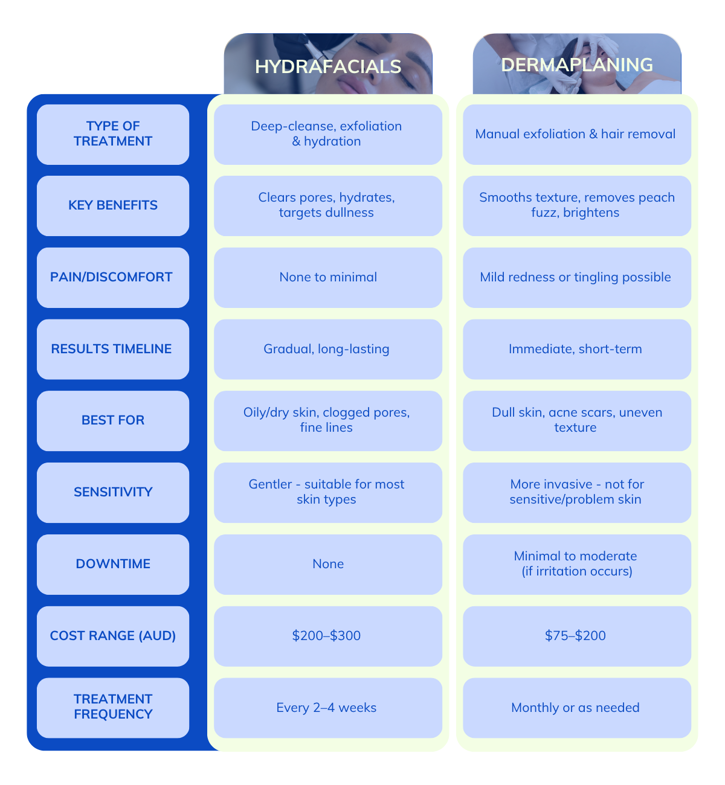
To consider which treatment will work best for you, ask yourself the following questions:
The most important factor to consider is whether you can complete the proposed treatment safely. Folks with sensitive skin, skin conditions such as eczema, rashes or skin growths may want to consider hydrafacial as a safer option and to avoid potential irritation.
What is your main objective for the treatment you are considering? For clogged pores, blackheads, or dryness, hydrafacial will provide a thorough cleanse. However, if you’re looking to target textured skin, dullness, or peach fuzz, dermaplaning will provide a more suitable option.
While both treatments will leave you feeling brighter and rejuvenated, the achieved outcome will differ. Hydrafacial benefits mean it is more likely to produce a plumping effect, as well as improving the overall youthfulness of your skin. The results are longer-lasting, but also take a little longer to emerge. Dermaplaning benefits will produce immediate results, and leave you with brighter and smoother-looking skin.
If cost is a factor for your treatment, hydrafacials generally cost between $200 and $300, while dermaplaning will usually cost between $75 and $200. However, it’s worth considering that the benefits of hydrafacials tend to last longer and the treatment includes multiple products like peels and serums.
As with all things in skincare, what you need will depend entirely on your specific situation, health and preferences. However, with some broad knowledge on the two treatments, you can make an educated decision on whether hydrafacials or dermaplaning are right for you.
Wellness delivered to your inbox.